Quick answer
Occupational therapy for toddlers helps children ages 1 to 3 build the skills behind everyday routines: feeding themselves, playing with toys, early dressing, and coping with sensory input and transitions. Signs worth checking include not finger-feeding or trying a spoon by about 18 months, avoiding touching foods or textures, rarely playing with toys using their hands, or frequent, intense meltdowns. Toddler OT is play-based and works best in the child’s own home with a parent involved.
In this article
- What does occupational therapy do for toddlers?
- Toddler milestones OTs pay attention to
- Signs your toddler may need occupational therapy
- What does a toddler OT session look like?
- ECI or private OT for toddlers in Texas?
- How do I get started?
- Related guides from our pediatric OTs
- Start in-home OT in Greater Houston
Toddlers change fast, which makes it hard to know whether a struggle is a phase or something to check. This guide covers the signs a toddler may benefit from OT, what a session actually looks like at this age, and how to get started in Texas, including how ECI and private OT fit together. If you’re concerned about a delay, our developmental delays page explains how we help.
What does occupational therapy do for toddlers?
At this age, a toddler’s “work” is play, eating, early self-care, and learning to manage their own body and feelings. A pediatric occupational therapist helps when something is getting in the way, for example hand skills for stacking and scribbling, tolerating new food textures, or calming down after being upset. Because toddlers learn through repetition with the people they trust, OT at this age is mostly about coaching parents to turn daily routines into practice.
Toddler milestones OTs pay attention to
These come from the CDC’s developmental milestones, which describe what most children (75% or more) can do by each age:
| Age | Milestones most toddlers reach |
|---|---|
| 18 months | Walks without holding on; scribbles; drinks from an open cup, with some spills; feeds themselves with fingers; tries to use a spoon |
| 2 years | Kicks a ball; runs; walks up a few stairs with or without help; eats with a spoon |
| 30 months | Uses hands to twist things, like doorknobs or lids; takes off some clothes, like loose pants or an open jacket; jumps with both feet; turns book pages one at a time |
| 3 years | Strings large beads; puts on some clothes, like loose pants or a jacket; uses a fork; draws a circle when shown how |
Missing a single milestone isn’t a diagnosis. The CDC advises parents not to wait if they have concerns, and to talk with their child’s doctor about developmental screening.
Signs your toddler may need occupational therapy
- Feeding: gags on or refuses most textures, eats only a handful of foods, or shows no interest in finger-feeding or using a spoon
- Hand skills: rarely reaches for, holds, or explores toys; uses only one hand; can’t stack a few blocks or scribble by around age 2
- Sensory: strongly avoids messy hands, grass, sand, baths, or haircuts, or constantly seeks crashing, spinning, or mouthing objects
- Regulation: frequent meltdowns that are much longer or more intense than peers’, or very hard to soothe
- Self-care: doesn’t help at all with dressing or undressing by about age 3
- Loss of skills: stops doing things they used to do. Talk to your pediatrician promptly if this happens.
For older children, see our guide to the common signs a child may need occupational therapy.
What does a toddler OT session look like?
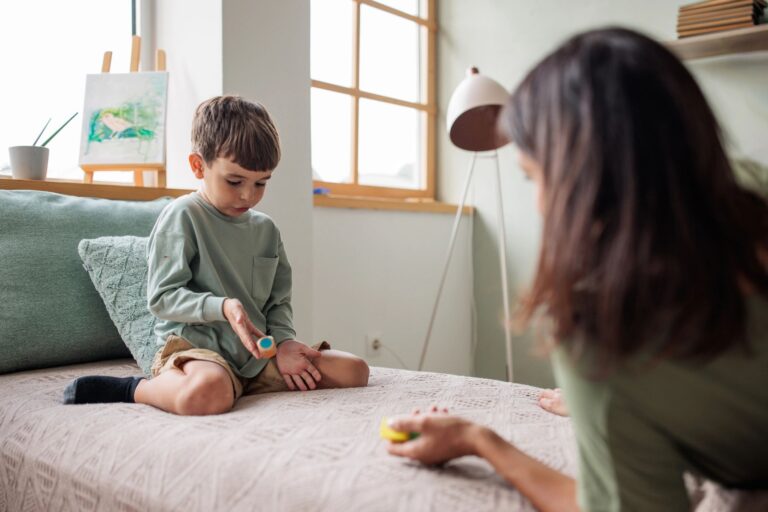
To your toddler, it looks like play. A session might involve stacking blocks, pulling apart pop beads, scooping and pouring in a bin of rice, practicing with a spoon at snack time, or swinging and crawling through a pillow obstacle course to help with body awareness. The OT watches how your child responds, adjusts the challenge, and shows you how to repeat the activities during the week.
That’s why in-home occupational therapy works especially well for toddlers. Sessions happen at your kitchen table, in your child’s play area, and during real routines like snack and bath prep, with familiar toys and no car ride or waiting room. Compare settings in in-home vs. clinic pediatric OT.
ECI or private OT for toddlers in Texas?
Texas Early Childhood Intervention (ECI), run by the Texas Health and Human Services Commission, serves children from birth to 36 months with developmental delays or certain diagnoses. Services end at age 3, when eligible children can transition to school district services. Private pediatric OT is another option, either instead of ECI or alongside it, and it can continue past age 3 without a change in provider. Our full comparison of ECI vs. private OT in Texas walks through eligibility, scheduling, and coverage.
How do I get started?
- Note what you’re seeing. Short videos of mealtimes or play can help a therapist understand your concerns.
- Talk with your pediatrician about screening at your child’s next well visit, or sooner if you’re worried.
- Schedule an OT evaluation. For toddlers, it’s play-based and usually takes place at home. Here’s what happens at a pediatric OT evaluation.
- Check coverage. If your child has Medicaid, read does Texas Medicaid cover pediatric OT.
How young can a child start occupational therapy?+
There is no minimum age. OT can help infants and toddlers as well as older children. What matters is whether your child is struggling with skills expected for their age, not their exact age.
Is my toddler too young to know if there’s a real delay?+
Development varies, but early concerns are worth checking. Toddler brains are highly adaptable, so getting support early, when it’s needed, can make skills easier to build. An evaluation can also simply reassure you that your child is on track.
How often do toddlers have OT?+
It depends on your child’s needs and goals. Many toddlers are seen once or twice a week, with parents practicing activities between sessions. Your therapist will recommend a plan after the evaluation. Our guide on how long pediatric OT takes explains what affects the timeline.
Do I need a doctor’s referral for toddler OT?+
No referral is required to begin with Collab Therapeutic Services. You can call us directly to schedule an in-home evaluation across Greater Houston.
Related guides from our pediatric OTs
- ECI vs. private OT in Texas
- Is it picky eating or a feeding problem?
- Sensory processing in kids: signs and how OT helps
- Fine motor milestones by age
Start in-home OT in Greater Houston
Collab Therapeutic Services brings pediatric occupational therapy to families in Houston, Katy, Sugar Land, Pearland, Cypress, Spring, and The Woodlands. Call (832) 232-3611 or request an intake call.
Milestones reflect the U.S. Centers for Disease Control and Prevention (CDC) developmental milestones; ECI eligibility information comes from Texas Health and Human Services. Every child develops at their own pace; this article is educational and not a substitute for an individual evaluation. Last updated November 2026.