Quick answer
Occupational therapy (OT) helps children do everyday tasks: using their hands, dressing, eating, handling sensory input, and staying regulated. Speech therapy helps with talking, understanding language, social communication, and sometimes swallowing. Physical therapy (PT) helps with big-body movement: walking, balance, strength, and coordination. Many children benefit from more than one. If you’re not sure where to start, begin with the area that’s getting in the way of daily life most, and ask your pediatrician about screening.
In this article
- What is the difference between OT, speech, and physical therapy?
- What does a pediatric occupational therapist do?
- When does a child need speech therapy?
- When does a child need physical therapy?
- Where do OT, speech, and PT overlap?
- Can a child do OT and speech therapy at the same time?
- How do I know where to start?
- Related guides from our pediatric OTs
- Start in-home OT in Greater Houston
When a pediatrician, teacher, or relative says your child “might need therapy,” it’s natural to wonder which kind. The three most common pediatric therapies overlap, and the names don’t always make the differences obvious. This guide explains what each one does, the signs that point toward each, and what happens when a child needs more than one. If OT looks like the right fit, a pediatric OT evaluation is the next step.
What is the difference between OT, speech, and physical therapy?
All three help children build skills and independence. The difference is the focus:
| Occupational therapy (OT) | Speech therapy (SLP) | Physical therapy (PT) | |
|---|---|---|---|
| Main focus | Everyday tasks and participation | Communication and swallowing | Movement and mobility |
| Common goals | Fine motor skills, handwriting, dressing, feeding, sensory processing, self-regulation, play | Speech sounds, vocabulary, understanding language, social communication, stuttering | Walking, balance, running and jumping, strength, posture, coordination |
| Who provides it | Licensed occupational therapist (OTR/L) or OT assistant | Licensed speech-language pathologist | Licensed physical therapist or PT assistant |
| A typical session might include | Play-based hand activities, practicing buttons or utensils, sensory and calming strategies | Picture and word games, sound practice, conversation and turn-taking play | Obstacle courses, balance work, stair practice, strengthening games |
What does a pediatric occupational therapist do?
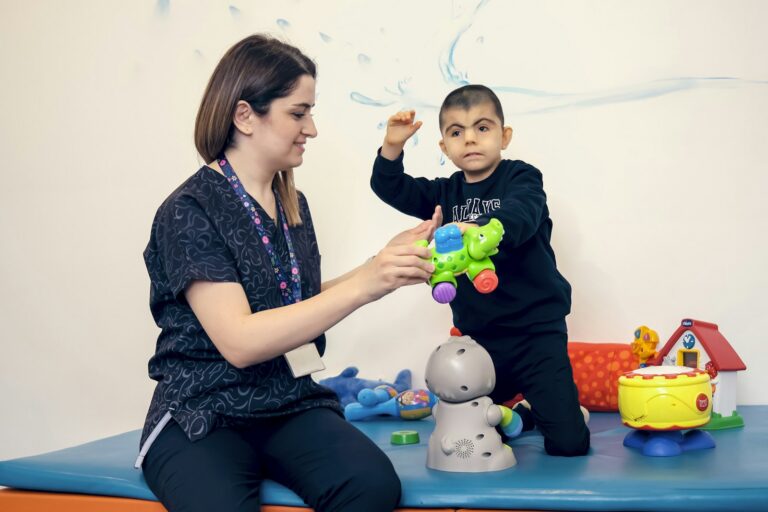
For children, “occupations” are the jobs of childhood: playing, learning, eating, dressing, and getting along at home and school. A pediatric OT looks at what’s making those jobs hard. That might be hand strength, coordination, visual-motor skills, sensory processing, attention, or emotional regulation. OT is often the right fit for a child who avoids crafts or writing, struggles with buttons and utensils, has big reactions to noise or textures, or melts down during everyday routines. Learn more in our guide to the signs a child may need occupational therapy.
When does a child need speech therapy?
Speech-language pathologists help with how a child communicates. Signs that point toward speech therapy include saying very few words for their age, being hard for others to understand, trouble following directions because of language rather than attention, stuttering, or difficulty with back-and-forth conversation. Speech therapists also treat some feeding and swallowing problems, which is one area where speech and OT can overlap.
When does a child need physical therapy?
Physical therapists focus on gross motor skills, the large movements of the body. A child might benefit from PT if they’re late to sit, crawl, or walk, fall far more than peers, walk on their toes, have trouble with stairs, running, or jumping, or show low muscle tone or uneven strength between sides of the body. PT also helps children recover after injury or surgery.
Where do OT, speech, and PT overlap?
Children don’t develop in neat boxes, so the therapies often meet in the middle:
- Feeding: OT addresses sensory aversions, utensil use, and mealtime routines; speech therapy addresses chewing and swallowing mechanics. Some children see both. See picky eating vs. a feeding problem.
- Coordination: PT works on big movements like balance and jumping; OT works on how those movements support daily tasks, like sitting upright to write or getting dressed while standing.
- Autism and developmental delays: Many children benefit from a team. OT often supports sensory needs, regulation, and self-care while speech supports communication. Read how OT helps children with autism.
Can a child do OT and speech therapy at the same time?
Yes, and it’s common. When therapists share goals, progress in one area often supports the other. A child who is better regulated may engage more in speech sessions; a child who can communicate needs may tolerate challenging OT tasks better. If your child sees more than one provider, ask them to share updates with each other and with you.
How do I know where to start?
- Write down what’s hardest day to day. Be specific: “can’t get dressed without a meltdown” is more useful than “behind.”
- Talk with your pediatrician. Ask about developmental screening and which evaluations make sense.
- Check early intervention if your child is under 3. In Texas, Early Childhood Intervention (ECI) serves children from birth to 36 months. Compare options in our guide to ECI vs. private OT in Texas.
- Request an evaluation in the area of biggest concern. A good therapist will tell you if they see needs outside their field and recommend the right referral.
Can an occupational therapist diagnose my child?+
OTs don’t diagnose medical or developmental conditions such as autism or ADHD. They evaluate skills and identify specific challenges, like fine motor delays or sensory processing difficulties, and create a treatment plan. Diagnoses come from physicians or psychologists.
Is occupational therapy the same as physical therapy for kids?+
No. PT focuses on large-body movement such as walking, balance, and strength. OT focuses on everyday tasks such as using the hands, dressing, eating, and handling sensory input. They often complement each other.
Does Collab offer speech or physical therapy?+
Collab Therapeutic Services provides pediatric occupational therapy. If our evaluation suggests your child would also benefit from speech or physical therapy, we’ll tell you so you can arrange that evaluation.
Do I need a referral to start pediatric OT?+
No referral is required to begin with Collab Therapeutic Services. You can call us directly to schedule an in-home evaluation across Greater Houston.
Related guides from our pediatric OTs
- Signs your child may need occupational therapy
- What happens at a pediatric OT evaluation?
- ECI vs. private OT in Texas
- In-home vs. clinic pediatric OT
Start in-home OT in Greater Houston
Collab Therapeutic Services brings pediatric occupational therapy to families in Houston, Katy, Sugar Land, Pearland, Cypress, Spring, and The Woodlands. Call (832) 232-3611 or request an intake call.
Descriptions of each discipline reflect guidance from the American Occupational Therapy Association (AOTA), the American Speech-Language-Hearing Association (ASHA), and the American Physical Therapy Association (APTA). This article is educational and not a substitute for an individual evaluation. Last updated November 2026.